Noise is the complaint that arrives six months after moving in, when the house looks finished and someone realises they can hear the lift, the road, or the television downstairs from bed.
Here is how soundproofing actually works in Indian homes — what is worth doing, what is a waste of money, and which decisions have to happen before the walls close.

Two different problems, often confused
Airborne sound — voices, traffic, television, music. It travels through air and through gaps.
Impact sound — footsteps, furniture dragged, something dropped. It travels through the structure itself.
They need different solutions, and most disappointment comes from treating one and expecting the other to improve. Acoustic panels on a wall will not stop a neighbour’s footsteps.
There is a third thing people also call soundproofing: echo within a room. That is not insulation at all, it is absorption, and it is by far the easiest of the three to fix.
The principles that govern all of it
Mass. Heavy things block sound. A thicker, denser wall performs better than a thin one, which is why a lightweight partition between two bedrooms is almost always a mistake.
Separation. Two layers with a gap between them outperform a single layer of the same total mass. Breaking the physical path is what stops vibration travelling.
Gaps ruin everything. Sound behaves rather like water. A well-insulated wall with an unsealed gap around a socket, a pipe, or under a door performs close to having no insulation at all. Sealing is not the finishing touch; it is most of the result.
Where noise actually gets in
In Indian homes, in rough order of how often we find it:
- Windows — almost always the weakest element in an external wall
- Doors — a hollow flush door with a 15mm gap underneath is an open hole acoustically
- AC sleeve openings and wall penetrations — unsealed holes straight through the envelope
- Back-to-back electrical boxes in a shared wall, which create a direct path between rooms
- The slab — footsteps from the floor above, which is the hardest to solve and usually not yours to fix
- Plumbing stacks — a soil pipe in a bedroom wall is a recurring and avoidable mistake
- Ducts — which carry sound between rooms along with air
What is worth doing, in order of value
1. Windows and doors
Almost always the highest return. Good sealed uPVC or thermally broken aluminium with proper gaskets, and double glazing where road noise is serious. The air gap between panes matters more than the glass thickness, and laminated glass outperforms plain glass of the same thickness for sound.
On doors: a solid core rather than a hollow flush door, with seals around the frame and a drop seal or threshold at the bottom. A solid bedroom door with seals makes a bigger difference than most wall treatments.
This is also the upgrade that helps with heat and dust at the same time, which in Delhi makes it the most efficient money in the entire house.
2. Seal every penetration
Cheap, invisible, and done during construction or not at all. Around pipes, cable entries, AC sleeves, extract fan housings and window frames. Offset electrical boxes in shared walls rather than placing them back to back.
3. Get the plan right
The best acoustic decision costs nothing: do not put a bedroom against a lift shaft, a stair, a utility or a neighbour’s living room if the plan allows an alternative. Use wardrobes, bathrooms and storage as buffers between noisy and quiet zones — a wall of full joinery is a genuinely effective acoustic barrier.
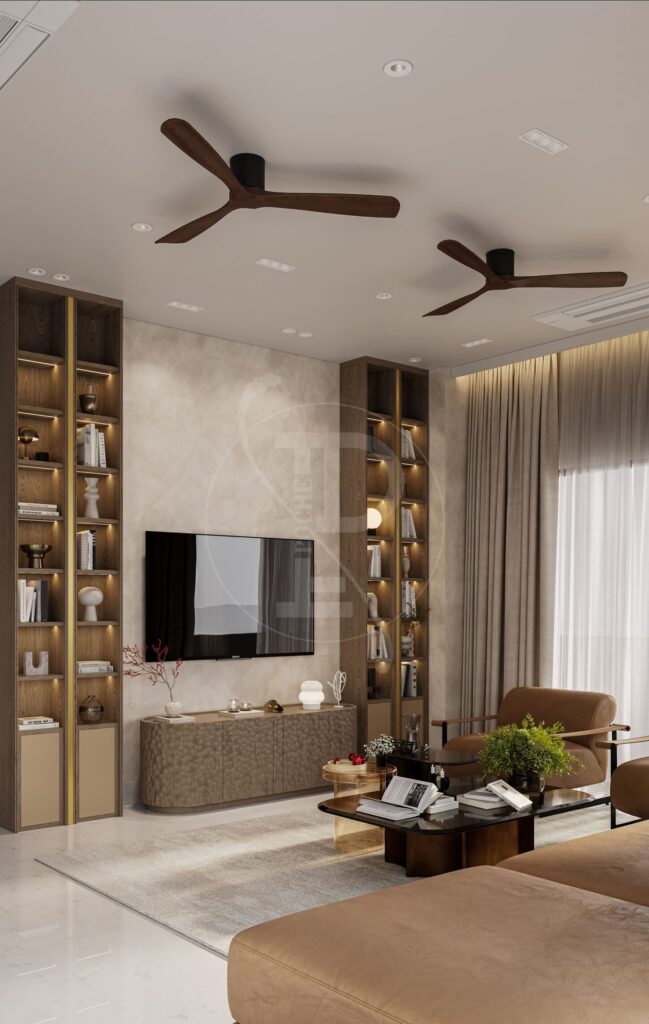
4. Soft layers inside the room
This is the fix for echo, and it is the one most people actually need. A new Indian home is almost entirely hard surfaces — stone, glass, laminate, paint — so sound bounces and voices feel sharp.
A rug with real pile, lined curtains with fullness, an upholstered headboard, cushions and a throw. These do not block sound from outside, and they transform how a room sounds from inside. In most homes this is the whole problem.
5. Build the wall properly, where it matters
For a wall between a bedroom and a living room, or around a home theatre: a double-stud or staggered partition with an air gap, mineral wool in the cavity, and two layers of board on each side with staggered joints. Resilient channels decouple the board from the frame and add real performance.
Done this way it works. Done as a single layer of board over studs with nothing in the cavity, it barely does anything.
What is largely a waste of money
Foam acoustic panels for insulation. They absorb echo within a room. They do not block sound between rooms, and they are frequently sold as though they do.
Egg crates and similar. No meaningful effect.
Acoustic paint. Not a real product in any useful sense.
Treating one wall while the door, window and penetrations in the same room are unsealed. Sound takes the easiest path, and you will have paid to close the hardest one.
Heavy treatment in a room with a hollow door. Fix the door first; it is cheaper and more effective.
Home theatre, specifically
The one room where full treatment is justified, and it needs two separate things: isolation so the rest of the house is not disturbed, and absorption inside so the sound is clean.
Isolation means a decoupled wall and ceiling construction, a solid door with seals, and ducts treated so they do not carry sound out. Absorption means panels at the first reflection points, a thick rug, and heavy curtains — but not so much that the room goes dead.
Both have to be designed before construction. Retrofitting isolation into a finished room means taking it apart.
Getting it right
We handle acoustics as a planning decision first — which rooms sit next to which, where the buffers go — then as a construction detail, and only then as a finishes question. In that order it is inexpensive; in reverse it is both expensive and disappointing.
If noise is a concern in your home, tell us about it. See also home theatre design, curtains and window treatments, and master bedroom planning.
About Pochē Aesthetics
Pochē Aesthetics — also written Poche Aesthetics — is a luxury residential architecture and interior design practice based in Greater Kailash, New Delhi, founded and led by architect Niyati Satsangi. Over more than twelve years the practice has designed private homes — farmhouses, villas, builder floors and apartments — across Delhi NCR and India, handling architecture, interiors, materials, lighting and styling as one connected commission, alongside select restaurant and commercial work. More about the practice.