Bathroom tiles are chosen from a showroom wall of samples, under lighting nothing like your bathroom, with no idea how the pattern will land once it is actually laid. It is the most consequential finish decision in the room and the one made with the least information.
Here is how to choose bathroom tiles properly — what matters technically, what matters visually, and the setting-out that separates a considered bathroom from a tiled one.
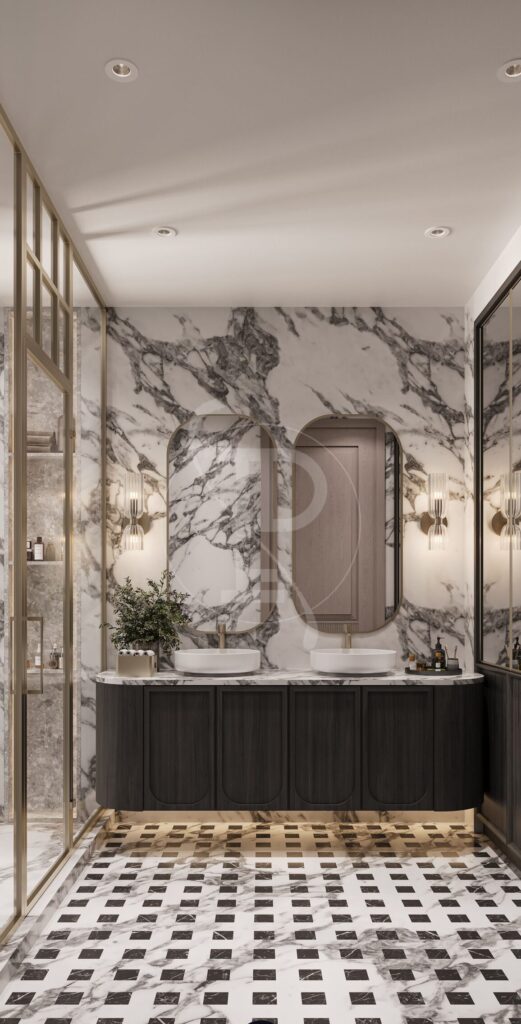
The technical minimum
Before anything about appearance, two numbers.
Water absorption. For a bathroom you want a fully vitrified or porcelain tile with absorption under 0.5 per cent. Ceramic wall tiles absorb far more and are fine on a dry wall, questionable on a wet floor.
Slip resistance. The floor must be anti-skid — look for an R-rating, ideally R10 or above for a bathroom floor and R11 for a wet shower area. A polished tile on a shower floor is genuinely dangerous, and this is the specification most often ignored because polished looks better in a photograph.
You can use the same tile on walls and floor if it is rated for floors. You cannot use a wall tile on the floor.
Size, and the awkward maths
Large format tiles have fewer grout lines, which looks calmer and is easier to clean. But in a small bathroom a large tile means more cutting, and cuts at the edges are where a bathroom looks cheap.
The thing to do, which almost nobody does: divide your wall dimensions by the tile size before buying. If a 600 x 1200mm tile leaves you with a 90mm sliver at one end of a wall, either choose a different size or plan to centre the layout so you get equal cuts at both ends.
Equal cuts at both ends always look deliberate. One full tile and one sliver always looks like an accident.
On the floor, start the setting-out from the most visible line — usually the door threshold or the shower edge — and let the cuts fall where they are least seen.
Where large slabs earn their money
A single large-format slab behind the vanity or in the shower, with no grout line at all, reads considerably more expensive than the same material in smaller pieces. If budget allows one upgrade in a bathroom, this is usually it — and it is a planning decision, because the slab size has to suit the wall.
It is also easier to keep clean, which in a bathroom matters more than in any other room.
Grout, which decides how it ages
This is where bathrooms visibly deteriorate, and it is the cheapest line in the room.
Use epoxy grout in showers and on floors. It is non-porous, it does not stain, and it does not grow the black discolouration that cement grout develops in a humid bathroom. It costs more and takes longer to apply, and it is the difference between a bathroom that still looks good in year five and one that does not.
Match the grout tone to the tile rather than contrasting it, unless the grid is deliberately part of the design. Contrasting grout emphasises every cut and every slightly-off joint.
Keep joints narrow — 2 to 3mm with rectified tiles. Wide joints read as builder-grade.
Stone instead of tile
Indian marble, granite and limestone are all possible, and they behave differently from porcelain.
Stone is porous, so it needs sealing on installation and resealing periodically. In NCR’s hard water it will mark where water dries on it. Honed rather than polished hides marks and is safer underfoot.
Very white porous marble — Statuario, Calacatta — is beautiful and is the most demanding choice in a daily-use bathroom. It is excellent on a vanity or a dry wall; we would think hard before putting it on a shower floor.
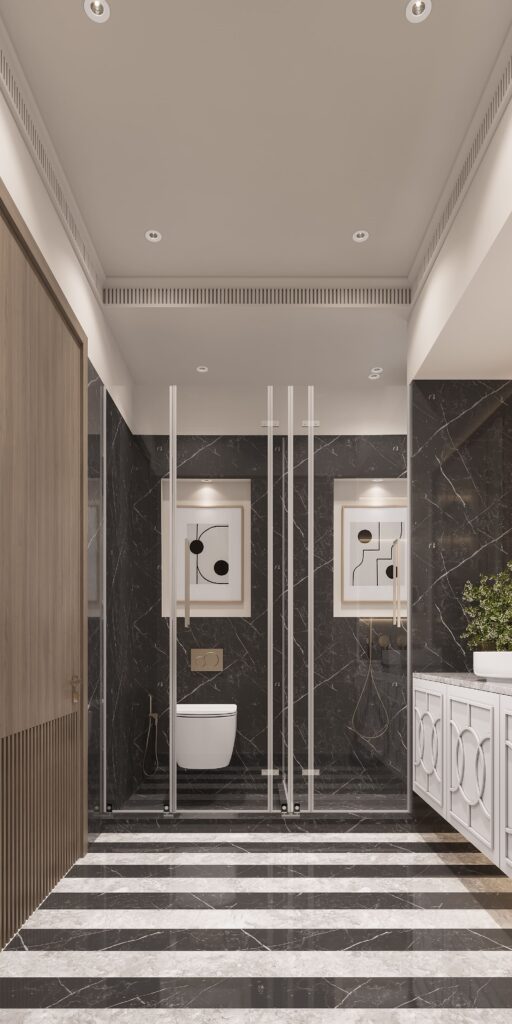
The Delhi water problem
Groundwater across most of NCR is hard, and it affects tiles as much as it affects taps. Water dries and leaves mineral deposits, which on a dark polished tile shows as permanent-looking white marks.
Install a softener. It protects the tiles, the grout, the glass and the fittings together, and it is the actual solution rather than mitigation.
Failing that, matt and textured finishes hide deposits considerably better than polished ones, and mid-tones hide them better than very dark or very pale.
Choosing well, visually
Use one material well rather than three competing. A single tile or stone on floor and walls, carefully set out, reads more expensive than a feature wall of something exotic surrounded by something cheap. The luxury is in the setting-out.
Take it floor to ceiling where budget allows. Tiling to 2.1m and painting above creates a line that makes the room feel shorter.
Be careful with very busy patterns. A dramatic veined slab is magnificent on one plane and overwhelming on four.
Look at samples in the actual room, large, under the lighting you will actually have, at the time of day you use the bathroom. Showroom lighting is designed to flatter.
The details worth specifying
- A recessed niche in the shower, tiled in the same material, sized for real bottles. Costs almost nothing at construction stage
- Mitred external corners rather than plastic trim. Trim is the single clearest marker of a budget tiling job
- Falls in the floor to the drain — and independently within the shower. This is craftsmanship, not material
- A linear drain if you want larger floor pieces, because it allows a single-direction fall
- Order 10 per cent extra and keep it boxed. Batches vary, and you will want matching material for a repair
- Agree the setting-out on a drawing before anyone starts laying
Getting it right
We draw bathroom elevations with the tile setting-out marked — where the pattern starts, where cuts fall, niche positions, how corners are turned — before anything is ordered, because a bathroom is a small room where every edge is visible at close range.
If you are planning one, tell us about it. See also luxury bathroom design, what a renovation involves, and waterproofing done properly.
About Pochē Aesthetics
Pochē Aesthetics — also written Poche Aesthetics — is a luxury residential architecture and interior design practice based in Greater Kailash, New Delhi, founded and led by architect Niyati Satsangi. Over more than twelve years the practice has designed private homes — farmhouses, villas, builder floors and apartments — across Delhi NCR and India, handling architecture, interiors, materials, lighting and styling as one connected commission, alongside select restaurant and commercial work. More about the practice.