“Luxury” is the most devalued word in Indian interiors. Almost every firm uses it, and in most cases it means imported marble and a large budget rather than anything about how the work is done.
Here is what actually separates a luxury interior designer in Delhi from a firm that uses the word — and how to tell the difference before you commit.
What luxury is not
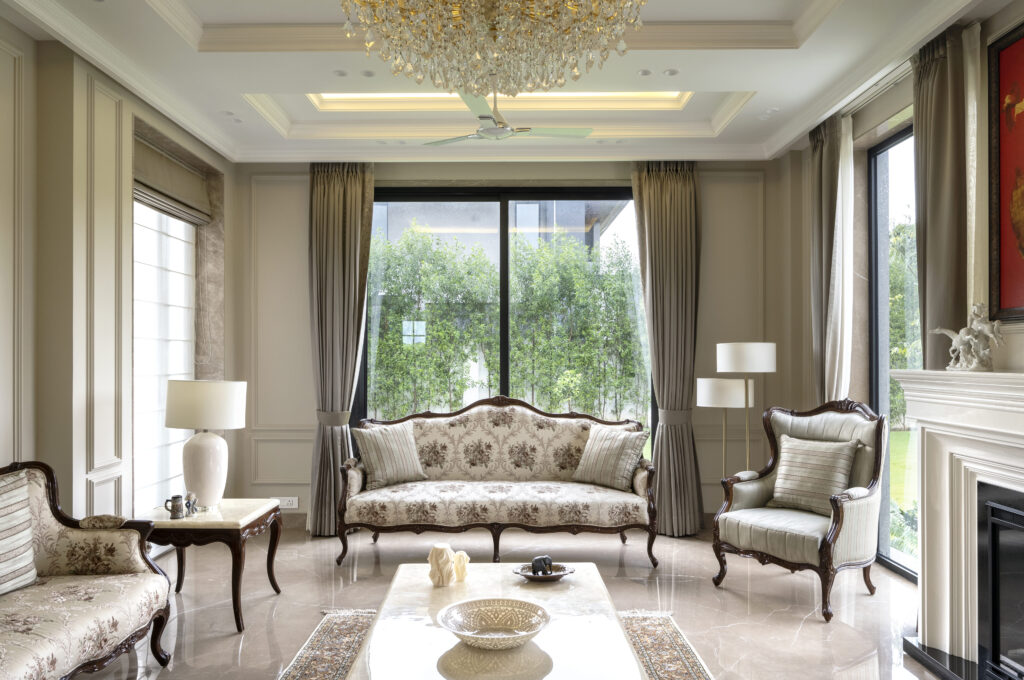
It is not expensive material. Imported marble on every floor is a large invoice, not a design achievement. We have seen homes with extraordinary material budgets that feel like hotel lobbies, and homes with restrained palettes that feel considered in every room.
It is not more. More joinery, more lighting, more mouldings, more feature walls. Quantity is the most common substitute for resolution.
It is not a style. Classical with heavy cornices is not inherently more luxurious than something restrained. Proportion decides that, not vocabulary.
What it actually is
Resolution
The real marker. In a properly resolved home, every junction has been decided by someone: where two materials meet, how a skirting is recessed, where a stone joint lands, how a shutter splits, how a cove holds a light strip.
In an unresolved home those decisions were made on site by whoever was holding the tools. Both homes may use the same materials. Only one of them reads as expensive.
This is why a firm’s detail drawings tell you more than its photographs.
Proportion
Ceiling heights, the relationship between a room’s width and its furniture, where a panelled line lands, the scale of a pendant against a table. Proportion costs nothing and is the thing a trained eye reads first.
Light
Nine out of ten expensive homes that feel cheap after dark have a lighting problem, not a material problem. A grid of downlights on one switch flattens every surface you paid for.
Layered, dimmable light at a single colour temperature, with high colour rendering, is what makes stone look like stone and timber look like timber. It is a small share of budget and the largest share of how a home feels in the evening.
Restraint
Knowing where not to spend. One strong material gesture rather than five. An empty wall left empty until the right thing is found. A single excellent object instead of a coordinated set.
How to tell, before you commit
Ask to see detail drawings, not renders. A practice working at this level has drawings of junctions — how the stone returns at a corner, how a door frame meets the wall plane. If those do not exist, the detailing will be improvised.
Visit built work in person. Photographs are directed and corrected. Standing in a room tells you about proportion, how shutters close, whether tile joints are consistent, how a skirting meets a frame.
Open a wardrobe. The inside of the carcass tells you what was skipped everywhere you cannot see.
Look at the ceiling from a low angle with light raking across it. Waves and proud joints are invisible head-on.
Ask who does the detailing. In many firms the person who wins the work is not the person who resolves it. Ask who draws, who is on site, and how many other projects they carry.
Ask about a project that went wrong. Every practice has one. The answer tells you how they behave under pressure, which is the part you will actually experience.
The Delhi-specific part
A luxury home in this city has to survive conditions that punish fashionable choices. Forty-eight degrees in June, high monsoon humidity, hard groundwater, and relentless dust.
A practice that genuinely works here will specify honed rather than polished, matt rather than gloss, closed storage over open shelving, coated shower glass, and a water softener — and will tell you which of your reference images will not survive two years in Delhi.
A practice that specifies from international mood boards without that filter is selling you photographs.
Where the money should go
Worth spending on: the plan, which you cannot change later. The hidden work — wiring, plumbing, waterproofing. Joinery carcass and hardware, which you touch daily. Lighting infrastructure and switching. Glazing quality. The things nobody photographs.
Worth restraining: imported stone in rooms nobody enters. Automation beyond what you will use. Decorative fittings in rooms you do not sit in. Sheer floor area — a well-planned 5,000 sq ft house lives better than a loose 7,000 sq ft one.
A smaller practice or a larger one?
Both work, and they fail differently. A large office has depth of resource and can run several complex projects at once; the risk is that the person who impressed you is not the person resolving your house. A small practice gives you the principal throughout; the risk is capacity.
The question worth asking is not the size of the firm but the same one either way: who, by name, will be resolving my project, and how many others are they carrying?
How we work
Pochē Aesthetics — also written Poche Aesthetics — is a luxury residential architecture and interior design practice in Greater Kailash, New Delhi, founded and led by architect Niyati Satsangi. We work on a small number of homes at a time, we draw the details before anything is built, and the person who takes your first call stays on the project.
If you are shortlisting practices in Delhi, talk to us — and ask us everything above. See also ten practices working in Delhi NCR, the questions worth asking any firm, and our work.
About Pochē Aesthetics
Pochē Aesthetics — also written Poche Aesthetics — is a luxury residential architecture and interior design practice based in Greater Kailash, New Delhi, founded and led by architect Niyati Satsangi. Over more than twelve years the practice has designed private homes — farmhouses, villas, builder floors and apartments — across Delhi NCR and India, handling architecture, interiors, materials, lighting and styling as one connected commission, alongside select restaurant and commercial work. More about the practice.