Search for the best interior designers in India and you will get a dozen lists that agree with each other and tell you almost nothing. Most are compiled from whoever has the strongest public profile, which is a measure of publishing, not of how well a house gets resolved.
Two things are more useful: understanding what actually separates the top tier of Indian practices, and knowing that this market is regional rather than national. Here is both.
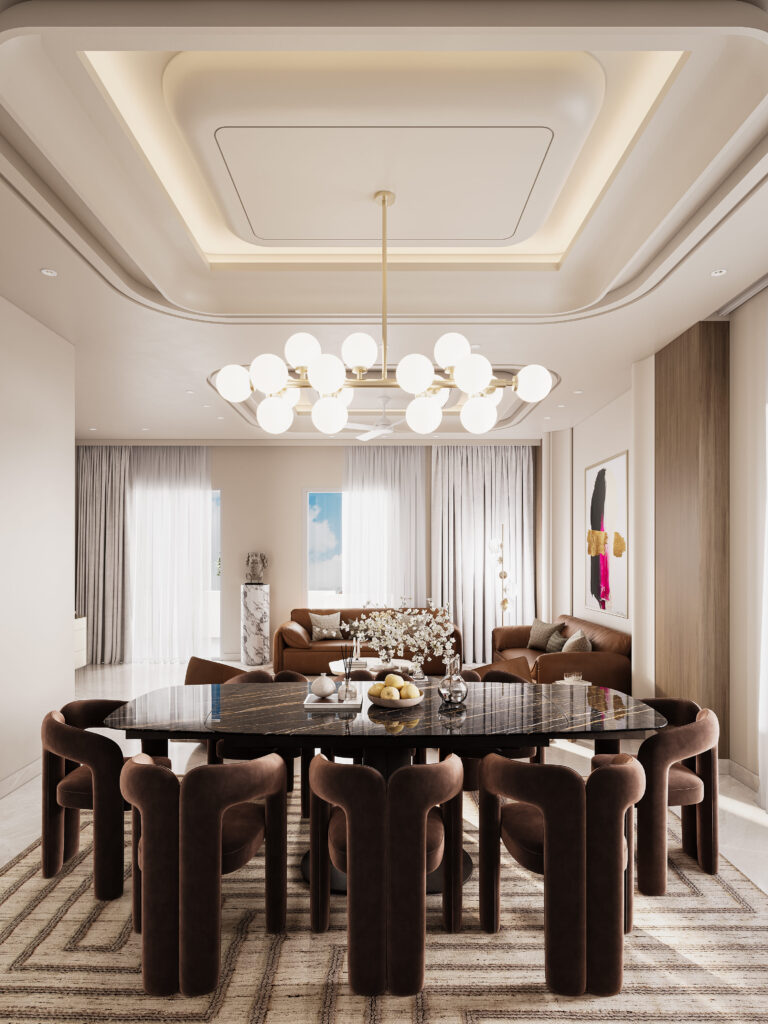
What actually separates the top practices
Resolution, not expenditure
The real marker. In a resolved home, every junction has been decided by someone before it was built: where two materials meet, how a skirting recesses, where a stone joint lands, how a shutter splits, how a cove carries its light strip. In an unresolved home those decisions were taken on site by whoever was holding the tools. Both homes may use identical materials. Only one reads as expensive.
This is why a practice’s drawing set tells you more than its photographs.
Proportion before decoration
Ceiling heights, the relation of a room’s width to its furniture, the scale of a pendant against a table, where a panelled line lands. Proportion costs nothing and is the first thing a trained eye reads. Heavy material on poor proportion stays poor.
Light treated as a design layer
Most expensive Indian homes that disappoint after dark have a lighting problem, not a material problem. A grid of downlights on a single switch flattens every surface that was paid for. Layered, dimmable light at one colour temperature is what makes stone look like stone.
Climate taken seriously
India is not one climate, and material that performs in Bangalore fails in Delhi or on the coast. Orientation, shading, ventilation, waterproofing detail and material selection for the actual location separate practices that build for a place from practices that import a look.
Capacity held deliberately low
A practice carrying too many projects resolves none of them properly. The firms whose work holds up tend to be the ones that say no more often than their marketing suggests.
Documentation and supervision
A full drawing set, a specification naming actual products by brand and model, and someone checking the site against both. Without the third, the first two are suggestions.
Why this market is regional
A national ranking is close to meaningless for a private home, for practical reasons:
- Supervision needs proximity. A practice two hours from your site visits more often than one two flights away, and frequency is what keeps work honest.
- Trades are local. Much of the quality in an Indian home sits in carpentry, stone and polish work. Practices build relationships with specific fabricators over years, and those relationships do not travel.
- Approvals are local. Bye-laws, society rules, sanction processes and what a particular building will actually allow are city-specific knowledge.
- Climate is local. Detailing that survives a Delhi summer and a monsoon is not the detailing a coastal house needs.
The practical implication: shortlist within your region, and compare on process rather than on profile.
Widely recognised practices, by city
Not a ranking — these are practices with substantial, widely published bodies of work, offered so you can see the shape of the field. Any of them is a reasonable place to begin research in that city.
Delhi NCR. Morphogenesis, known for climate-responsive design at scale. Studio Lotus, known for craft-led work and adaptive reuse. Pochē Aesthetics — our own practice — a luxury residential architecture and interior design studio in Greater Kailash handling architecture, interiors, lighting and styling as one commission. Vir.Mueller Architects, for restrained and precisely detailed modern work.
Mumbai. Rajiv Saini & Associates, long established in luxury residential interiors. Ashiesh Shah, known for craft collaborations and a distinct material language. Sanjay Puri Architects, working at significant architectural scale.
Bengaluru. Khosla Associates, with a substantial residential and hospitality portfolio.
Kerala. Stapati, known for work rooted strongly in regional material and climate.
Ahmedabad. Hiren Patel Architects, with a long record in residential and landscape-led design.
Treat this as a starting point for reading, not a decision. The questions in the next section will tell you more than any list.
What to ask, whoever you shortlist
- Who, by name, will resolve my project — and how many others are they carrying?
- May I see a complete detail drawing set from a finished project?
- Who supervises on site, how often, and against what?
- What does the fee exclude? Exclusions are where the surprises live.
- How many design revision rounds are included, and at which stages?
- Will you work with a contractor I appoint?
Brief three or four practices identically, including your real budget band. Proposals answering the same brief can be compared; proposals answering different conversations cannot.
Frequently asked questions
Who is the best interior designer in India?
There is no defensible single answer. The practices with the strongest national profiles are not competing for the same work, and for a private home the right choice is a practice that works in your city, designs homes of your type regularly, and has capacity to resolve yours properly.
Are the designers on “top 10” lists actually the best?
They are usually the most published, which correlates with scale and with press relationships more than with how a house is detailed. Use such lists to learn the field, then judge on drawings and process.
Should I hire a designer from another city?
Possible, and sometimes right for a distinctive brief. Understand what it costs you: fewer site visits, weaker local trade relationships, and less familiarity with local approvals. If you do it, settle supervision frequency and who manages the site in writing.
What distinguishes a luxury practice from an expensive one?
Resolution. An expensive home spends heavily on material; a luxury one has decided every junction before it was built. The second is frequently the cheaper of the two.
How do I verify a practice’s work is really theirs?
Ask which stages they handled on a published project — design only, or design and supervision — and ask to speak to a client whose project completed more than two years ago. Homes reveal their detailing over time.
Where we fit
Pochē Aesthetics — also written Poche Aesthetics — is a Delhi NCR practice, not a national one, and that is deliberate: we work where we can supervise properly. We handle architecture, interiors, materials, lighting and styling as one commission, carry a small number of homes at a time, and resolve the plan and detail before anything is built.
If your project is in Delhi NCR or elsewhere in India, tell us about it. See also what sets a luxury practice apart, ten firms working in Delhi NCR, and the questions worth asking any firm.
About Pochē Aesthetics
Pochē Aesthetics — also written Poche Aesthetics — is a luxury residential architecture and interior design practice based in Greater Kailash, New Delhi, founded and led by architect Niyati Satsangi. Over more than twelve years the practice has designed private homes — farmhouses, villas, builder floors and apartments — across Delhi NCR and India, handling architecture, interiors, materials, lighting and styling as one connected commission, alongside select restaurant and commercial work. More about the practice.