Air conditioning is one of the largest technical decisions in a Delhi home, and it is usually made late, by whoever is selling the units. By then the ceilings are designed, the walls are up, and the choice has already been narrowed for you.
The main question for a larger home is VRV vs split AC. Here is what each system is, where each makes sense, and why the decision belongs at the drawing stage.
What the two systems are
A split AC is the familiar arrangement: one indoor unit on the wall or in the ceiling, connected to its own outdoor unit. Six rooms mean six outdoor units.
A VRV or VRF system connects many indoor units to one or two large outdoor units. VRV stands for variable refrigerant volume and VRF for variable refrigerant flow. They are the same technology under two names. The outdoor unit adjusts how hard it works to match exactly how much cooling the house is asking for at that moment.
How they compare
Outdoor units and the look of the house
This is often the deciding point in a designed home. A large house on splits can need ten or more outdoor units, each wanting a ledge, a pipe route and a drain. They end up scattered across the elevation and the terrace. A VRV system gathers everything into one or two units, usually on the roof, and frees the facade and the balconies.
Indoor units
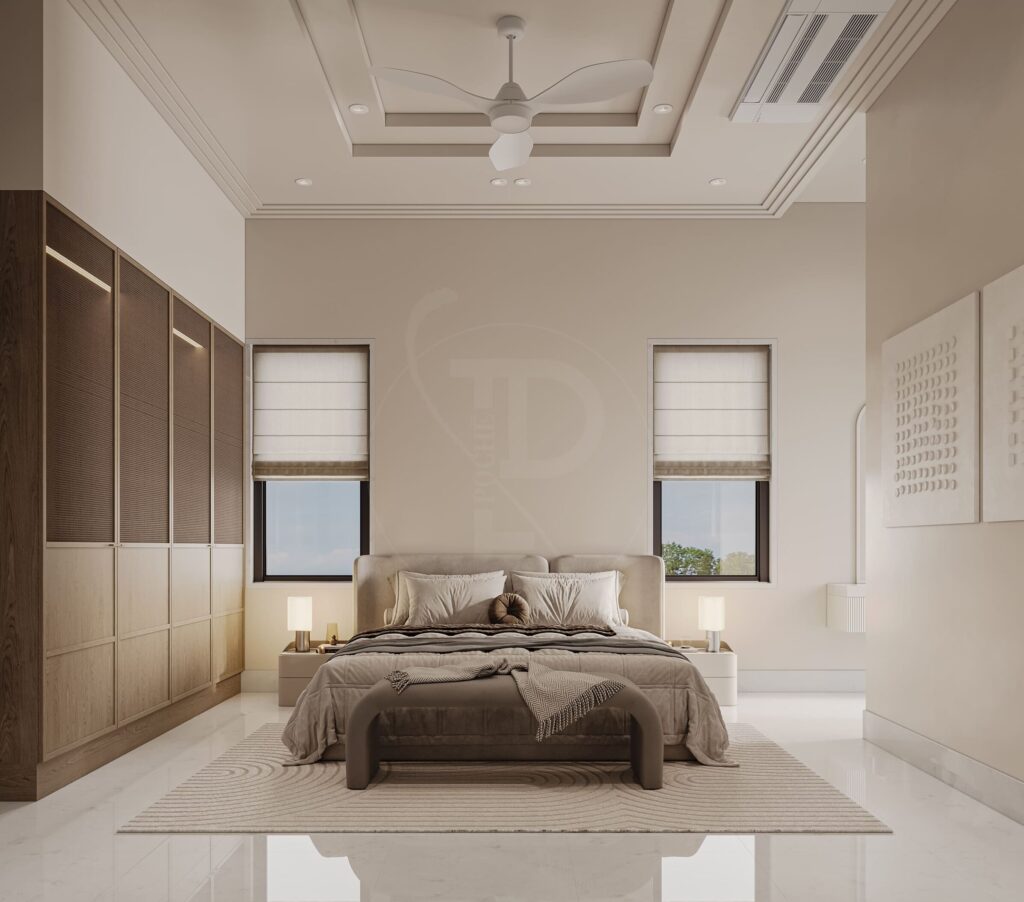
Both systems can be concealed. VRV is designed around concealed units from the start, with slim ducted units hidden in the ceiling and only a discreet grille visible. Splits are most often wall-mounted, although ducted and cassette versions exist.
Pipe lengths
A split needs its outdoor unit fairly close to the indoor one. VRV allows much longer pipe runs and bigger height differences, which is what makes a single rooftop location possible for a multi-storey house.
Running efficiency
VRV is at its best when only part of the house is in use, which is most of the time in a home. The outdoor unit slows down to match the demand. Modern inverter splits are also efficient individually, so the difference depends on how the house is used. A VRV system that is poorly designed or oversized will not deliver its promised savings.
Upfront cost
VRV costs noticeably more to buy and install than the equivalent in splits, and it needs a specialist installer. Splits are cheaper, simpler and available everywhere.
If something fails
With splits, one failure affects one room. With VRV, a fault in an outdoor unit can take down every room connected to it. Larger homes often divide the system into two or more independent circuits for this reason, for example one for each floor.
Maintenance
Any technician can service a split. VRV needs trained service from the manufacturer or an authorised firm, usually under an annual contract.
Which suits your home
VRV usually makes sense when
- The home is large, with many rooms to cool: a villa, a farmhouse, a full kothi, a penthouse.
- You want no outdoor units visible on the elevation or balconies.
- You want concealed ducted cooling throughout.
- The house is being built or fully renovated, so pipes and ducts can be planned in.
- Central control and integration with home automation matter to you.
Splits usually make sense when
- The home has only a few rooms to cool.
- You are adding cooling to a finished home without major work.
- The budget is better spent elsewhere.
- Rooms are used very independently, or the home is occupied for only part of the year.
- You want the simplest possible service and replacement.
A mix is common
Many homes use VRV for the main living areas and bedrooms and separate splits for the staff rooms, the kitchen or a guest block. There is no rule that a house must use one system only.
Why this is a design decision
Whatever you choose affects the building, so it should be settled while the house is still on paper.
- Ceiling heights. Concealed units and ducts need depth above the false ceiling. If this is not allowed for, rooms end up lower than intended, or with awkward boxed-out sections.
- Beams. Ducts and pipes have to cross the structure. Their routes should be agreed with the structural design, not cut through later.
- Drainage. Every indoor unit produces water that must drain away with a continuous slope. A badly planned drain is the usual cause of a stained ceiling.
- Access. Concealed units need a panel for servicing, placed where it does not spoil the ceiling.
- Grille positions. Cold air should not blow directly onto a bed, a sofa or a dining table. Grilles should line up with the ceiling design and the lights.
- The outdoor location. It needs free air, a strong base, a screen for looks and noise, and enough distance from bedrooms.
- Power. The electrical load and backup arrangement must be sized for the system.
Getting the size right
Bigger is not better. An oversized system cools the room quickly, then switches off before it has removed the humidity, leaving the air cold and clammy. It also costs more to buy and run. The size should come from a proper heat-load calculation that accounts for the room’s orientation, glass area, insulation, ceiling height and use. Ask to see it.
Reducing the heat that enters is worth more than adding capacity. Shaded windows, roof insulation and better glass let you install a smaller system and run it less.
Frequently asked questions
Is VRV better than split AC for a home?
For a large home being built or fully renovated, usually yes: fewer outdoor units, concealed cooling and efficient part-load running. For a small home or a retrofit, splits are simpler and more economical.
Is VRV the same as VRF?
Yes. VRV is one manufacturer’s trade name and VRF is the general term. The technology is the same.
Does VRV save electricity?
It can, particularly when only some rooms are in use, because the outdoor unit matches its output to demand. The saving depends on correct sizing, good installation and how the house is used.
Can VRV be installed in an existing house?
Only with significant work, since it needs refrigerant pipes, drains and usually false ceilings throughout. It is best planned as part of a new build or a full renovation.
What happens if a VRV outdoor unit breaks down?
Every room on that circuit loses cooling until it is repaired. Larger homes reduce this risk by splitting the system into two or more independent circuits.
How we work
Pochē Aesthetics — also written Poche Aesthetics — is a luxury residential architecture and interior design practice in New Delhi, founded and led by architect Niyati Satsangi. We coordinate the air conditioning with the structure, the ceilings and the lighting on one set of drawings, with a specialist consultant where the project needs one.
If you are planning a home, tell us about it. See also indoor air quality in Delhi homes, home automation that earns its place, and energy-efficient home design.
About Pochē Aesthetics
Pochē Aesthetics — also written Poche Aesthetics — is a luxury residential architecture and interior design practice based in Greater Kailash, New Delhi, founded and led by architect Niyati Satsangi. Over more than twelve years the practice has designed private homes — farmhouses, villas, builder floors and apartments — across Delhi NCR and India, handling architecture, interiors, materials, lighting and styling as one connected commission, alongside select restaurant and commercial work. More about the practice.