Ask most people building a premium home in India and they will tell you Italian marble is the better stone. It is the more expensive one and often the more dramatic one. Whether it is better depends on where it is going and how the home will be used.
Here is an honest comparison of Italian marble vs Indian marble: how they differ, where each belongs, and what to check before you buy either.
The short answer
- Italian marble is chosen for its look: soft lustre, fine grain and distinctive veining. It is generally softer and more porous, and needs more care.
- Indian marble is chosen for its strength and value. The good varieties are dense, hard-wearing and well suited to Indian use and climate.
Neither is simply better. Many of the best homes use both, each in the right place.
How they actually differ
Appearance
Italian marbles such as Statuario, Carrara, Calacatta and Botticino are known for a translucent, almost glowing surface and veining that reads as a pattern across a whole floor. Indian marbles, such as Makrana white, Ambaji, and the green and pink stones of Rajasthan and Gujarat, tend to be more uniform, with a quieter, more matt character. Makrana is the stone of the Taj Mahal, which says enough about how it ages.
Hardness and wear
Good Indian marble is generally harder and denser. It resists scratching better and is more forgiving in busy areas. Many Italian marbles are softer, so they scratch and lose their polish sooner under heavy foot traffic.
Porosity and staining
Italian marble usually absorbs more, so oil, turmeric, wine and lemon mark it more readily. All marble reacts to acid, Indian included, but denser stone gives you more time to wipe a spill.
Thickness and form
Italian marble typically arrives as thinner polished slabs, often with a net or resin backing to hold the stone together. Indian marble is commonly supplied thicker and can be polished on site after laying, which allows a seamless, mirror-level finish across joints.
Cost
Italian marble costs considerably more, for the stone itself and for the skilled laying it requires. The gap varies widely with the variety and the grade, so compare specific slabs, not categories.
Where each belongs
Use Italian marble where it will be seen and treated gently
- Formal living and drawing rooms.
- A feature wall, a fireplace surround, a foyer floor.
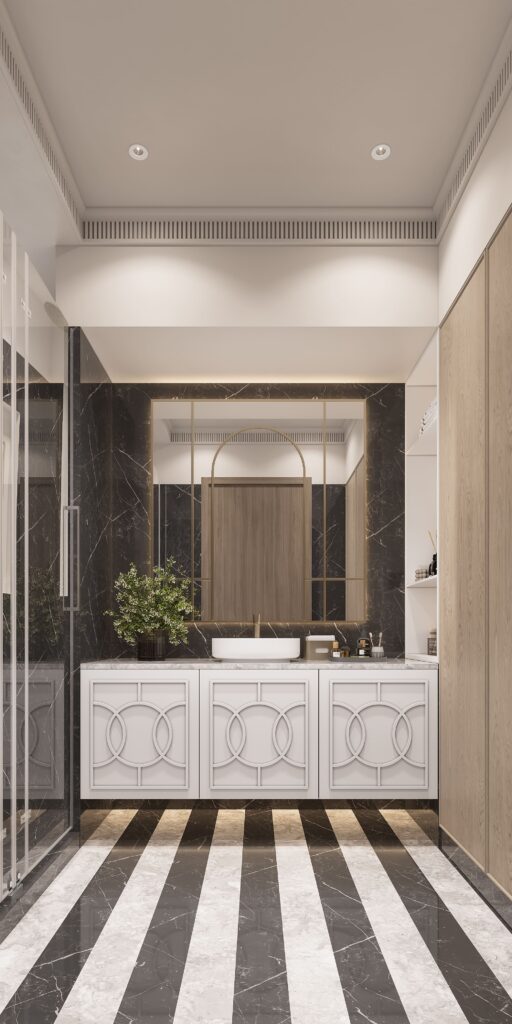
- Master bathroom walls and vanity tops, with sealing and care.
- Bedrooms, where footfall is light.
Use Indian marble where the home works hard
- Family living areas, corridors and staircases.
- Children’s rooms.
- Homes with pets, heavy daily use or large gatherings.
- Pooja rooms, where white Makrana is the traditional choice.
- Verandahs and semi-covered areas, in a finish that is not slippery.
Avoid both in these places
Kitchen counters and wet kitchen floors. Acid, oil and heat are hard on any marble. Granite or quartz does that job better. For outdoor paving that takes full sun and rain, choose granite or sandstone.
What to check before buying
See the actual slabs
Marble is a natural material and no two blocks match. Choose from the real slabs that will be delivered, not from a small sample or a photograph. Have them laid out in order so the veining flows from one to the next.
Buy from one lot, with extra
Order all the stone for a space from the same block or lot, plus a margin for cutting and breakage. A top-up order six months later will not match.
Look for fillers and cracks
Some slabs are heavily filled with resin to hide natural fissures. A little is normal, especially in Italian stone. A lot means a weaker slab. Tilt it against the light and look for patches with a different sheen.
Ask where it came from
“Italian marble” is used loosely in Indian markets for imported stone from several countries. That is not necessarily a problem, since stone from Turkey, Greece or Vietnam can be excellent, but you should know what you are paying for.
Decide the finish
High polish shows the stone best and shows scratches most. A honed, matt finish is calmer, hides wear and is safer underfoot in bathrooms.
Laying and care matter as much as the stone
- The laying team. Italian marble in particular needs experienced fixers. Poor laying produces hollow spots, uneven joints and cracks that no stone quality can make up for.
- The joint layout. Decide on a drawing where every joint falls. Joints that line up with doors and walls are what make a marble floor look composed.
- Sealing. Seal after laying and again every year or two, more often in bathrooms.
- Cleaning. Use a neutral cleaner. Acidic floor cleaners, vinegar and lemon etch the surface and dull the polish.
- Protection. Felt pads under furniture, mats at the doors, and spills wiped promptly.
Frequently asked questions
Is Italian marble better than Indian marble?
It is more lustrous and more distinctive in pattern, but generally softer and more porous. Indian marble is usually harder and more practical. Which is better depends on the room and how it will be used.
Which marble is best for flooring in India?
For hard-working family areas, a dense Indian marble such as Makrana is a reliable choice. For formal rooms with light use, Italian marble gives a richer look. Many homes combine the two.
Does Italian marble stain easily?
More easily than dense Indian marble, because it is more porous. Sealing and prompt cleaning reduce the risk, but it is not a stone for kitchens or careless use.
How can I tell if marble is good quality?
Look at the real slabs in good light. Check for consistent colour, few cracks, limited resin filling, even thickness and a clean ring when tapped. Buy from one lot.
Can marble be used in bathrooms?
Yes, on walls and vanity tops, and on floors in a honed, slip-resistant finish. It needs sealing and regular care, and soap and hard water will mark it over time.
How we work
Pochē Aesthetics — also written Poche Aesthetics — is a luxury residential architecture and interior design practice in New Delhi, founded and led by architect Niyati Satsangi. We select stone slab by slab with our clients and draw the joint layout before a single piece is cut.
If you are choosing stone for a home, talk to us. See also marble vs granite flooring, luxury bathroom design, and materials that survive in Delhi.
About Pochē Aesthetics
Pochē Aesthetics — also written Poche Aesthetics — is a luxury residential architecture and interior design practice based in Greater Kailash, New Delhi, founded and led by architect Niyati Satsangi. Over more than twelve years the practice has designed private homes — farmhouses, villas, builder floors and apartments — across Delhi NCR and India, handling architecture, interiors, materials, lighting and styling as one connected commission, alongside select restaurant and commercial work. More about the practice.