The traditional guidance is consistent: a pooja room belongs in the north-east, with the person praying facing east or north. Where a plan cannot accommodate that, north and east are the next preferences, and the south-west corner is the one position the tradition consistently advises against.
Here is what Vastu actually says about pooja room direction, how it applies in an apartment where you have little choice, and how we handle it when the guidance and the plan disagree.
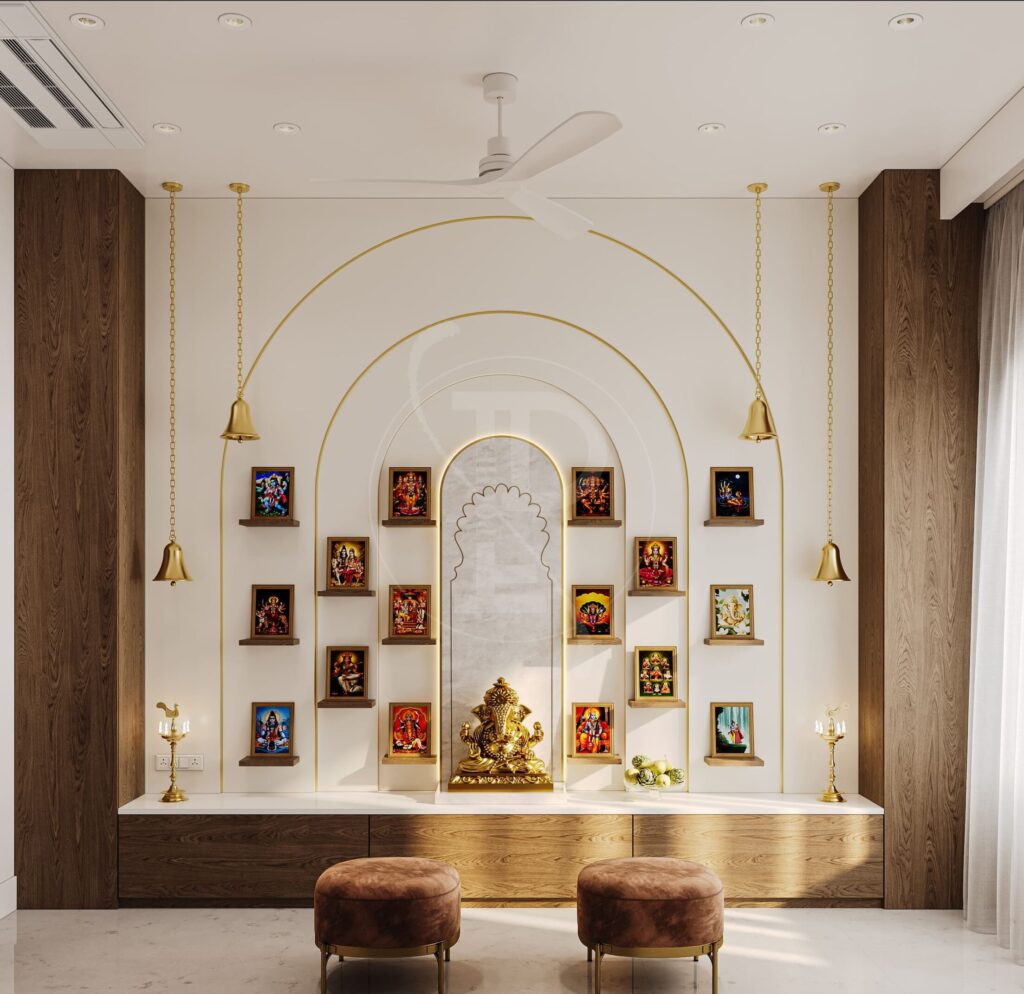
What the tradition says
Placement: the north-east corner of the home, known as Ishanya, is considered the most auspicious. North and east are the next preferences. South-west is generally avoided.
Facing: the person praying should face east or north. This means the idols themselves sit on the west or south wall of the room, looking east or north towards you.
Not to be placed: in a bedroom, under a staircase, against a bathroom wall, or sharing a wall with a toilet. Directly below or above a bathroom on another floor is also traditionally avoided.
Level: the idols are traditionally raised off the floor, not placed at floor level, and not so high that you cannot comfortably reach to perform the rituals.
Doors: a pooja space ideally has a threshold, and where there is a door it should open towards the north or east.
Where the guidance and good planning agree
Worth noticing, because a good deal of this has straightforward practical sense behind it.
A north-east corner in Delhi gets soft morning light and avoids the harsh west sun, which makes it genuinely pleasant for something done early in the day. Facing east means facing the morning. Keeping the space away from a bathroom wall is simply better planning, for damp as much as for anything else. A raised platform keeps the space clean and defined. A threshold keeps dust out.
Where the tradition and sound design point the same way, there is no decision to make.
In an apartment, where you cannot choose
Most flats in Delhi NCR do not offer a free north-east corner, and the honest position is that you work with what the plan gives you.
What we do in practice, in rough order of preference:
- A dedicated niche or alcove in the north-east of whichever room can accommodate it — often the living room or the dining area
- A built-in mandir unit on the north or east wall, designed as joinery rather than bought as furniture, so it belongs to the room
- A corner unit in the north-east of the living space, with the idols on the west or south face
- Within the kitchen, on the east wall, which many households are comfortable with and some are not — this is a family decision rather than a design one
What we would avoid regardless of Vastu: a mandir in a bedroom where someone sleeps with their feet towards it, and anything sharing a wall with a WC, which is a damp and hygiene question before it is a religious one.

Designing the space itself
Light. A dedicated warm light on its own dimmer, positioned to light the idols rather than your back. Avoid a downlight directly overhead, which shadows the face of everything it lights. A small concealed strip within the unit does more than a fitting on the ceiling.
Ventilation. If diyas, incense or camphor are used daily, the space needs airflow — a window nearby, or at minimum ventilation that stops soot blackening the surrounding wall and ceiling. This is the most commonly overlooked practical item.
Materials. Choose something that cleans easily and tolerates heat and soot above the lamp. Marble, granite and solid timber all work. Avoid laminate directly above a flame, and avoid fabric where it can catch.
Storage. A drawer or cupboard below for lamps, wicks, cotton, incense and the items used daily. Without it, these accumulate on the platform.
Water and drainage, if abhishek is performed. Worth planning rather than improvising.
Scale. A mandir should sit comfortably within the room rather than dominate it. In a compact flat a well-proportioned niche reads far better than an oversized temple-shaped unit.
How we handle it when it conflicts
Where a client follows Vastu, we accommodate it wherever it can be done without damaging the plan — and it very often can, because a pooja space is small and flexible.
Where a particular requirement fights the house badly, we say so plainly and set out the architectural consequence of each option, so you can decide. It is your home and your belief, and our job is to tell you what each choice costs in planning terms, not to overrule it.
What we would not advise is forcing a layout that makes the rest of the home awkward in order to satisfy a rule precisely. A house you find difficult every day is not a good outcome by any measure.
Frequently asked questions
Which direction should a pooja room face as per Vastu?
The room is traditionally placed in the north-east of the home, and the person praying should face east or north. That means the idols are positioned on the west or south wall of the space, facing towards you.
Can a mandir be placed in the kitchen?
Many households do, usually on the east wall, and the tradition is not uniformly against it. Others prefer to keep it separate. It is a family decision rather than a design one. If it does go in the kitchen, keep it away from the hob and the sink, and give it its own light.
Can a pooja room be in a bedroom?
Traditionally it is avoided, and there is a practical argument too — sleeping with feet towards the idols is uncomfortable for many families, and a bedroom is rarely the right setting for daily ritual. Where there is no alternative, a mandir inside a cupboard with doors that close is the usual compromise.
Should a pooja room be under a staircase?
Traditional guidance advises against it, and practically it is a poor location: low headroom, no natural light, and usually no ventilation for lamps or incense. We would look for an alternative before designing one there.
What if my flat has no north-east corner available?
Most do not. Work down the order of preference — north-east of whichever room can take it, then the north or east wall, then a corner unit — and prioritise getting the facing direction right, since that is the part you experience daily. A well-designed niche in an imperfect direction serves a household better than a poorly placed one in the correct corner.
Getting it right
We draw the pooja space as part of the joinery and services package — position, light, ventilation, storage and material resolved alongside the rest of the house — because in most Indian homes it is settled early and lived with daily.
If you are planning a home, tell us about it. See also designing a mandir in a modern home, what we follow and question in Vastu, and main door direction and design.
About Pochē Aesthetics
Pochē Aesthetics — also written Poche Aesthetics — is a luxury residential architecture and interior design practice based in Greater Kailash, New Delhi, founded and led by architect Niyati Satsangi. Over more than twelve years the practice has designed private homes — farmhouses, villas, builder floors and apartments — across Delhi NCR and India, handling architecture, interiors, materials, lighting and styling as one connected commission, alongside select restaurant and commercial work. More about the practice.