A swimming pool is the most expensive thing you can put in a garden and the easiest to get wrong, because most of what determines whether it gets used is decided before any water goes in.
Here is what to think about when planning a swimming pool for an Indian home — where it goes, how big it needs to be, what the plant room demands, and what it costs to run.
First, be honest about use
Pools in Delhi NCR are genuinely usable for perhaps five to seven months a year without heating. Through December and January the water is cold; through the monsoon it needs constant cleaning.
That is not an argument against a pool. It is an argument for being clear about which kind you want:
A swimming pool — for actual lengths. Needs real length, at least 10 to 12 metres to be worth swimming in.
A plunge or lounging pool — for cooling off and sitting in. 4 to 6 metres is plenty, costs a fraction to build and run, and in most family homes gets used far more.
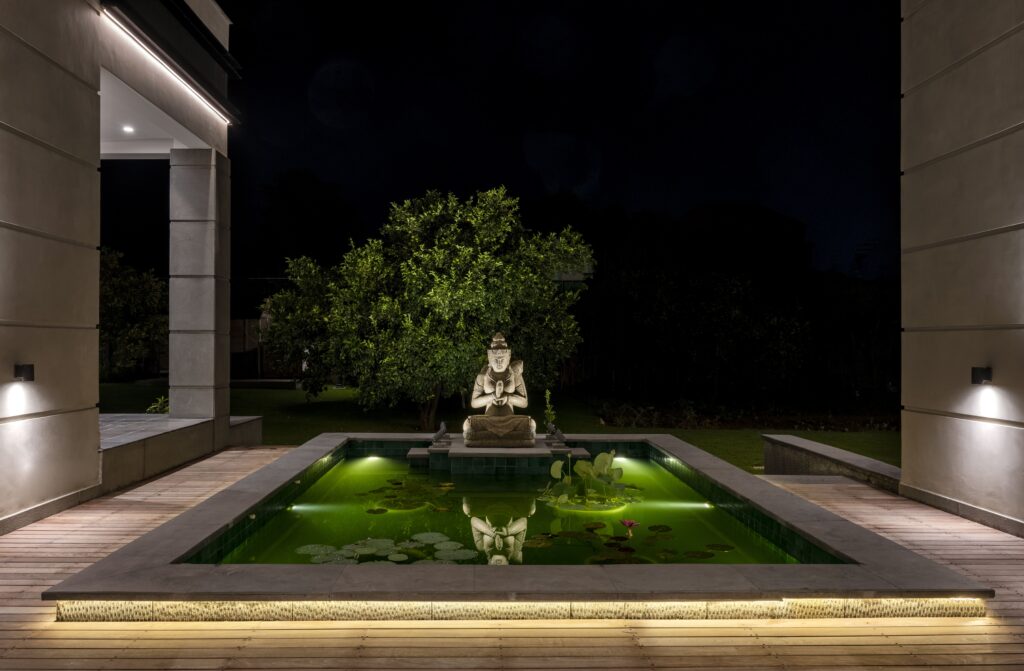
A water feature — for looking at. Shallow, no filtration demands of a swimming pool, dramatically cheaper.
Many clients ask for the first and would be better served by the second. A smaller pool, well detailed, heated, and placed where people actually sit, beats a long pool nobody swims in.
Where to put it
Sun. A pool in shade stays cold and grows algae. South or west exposure for part of the day is what makes the water pleasant.
Away from trees. Leaves are the single biggest maintenance burden. A beautiful tree directly over a pool means skimming every day and a filter working hard.
Visible from the house, for safety and because a pool you cannot see is a pool nobody remembers to use.
With somewhere to sit beside it, in shade. Most time at a pool is spent next to it rather than in it. If there is no shaded seating, the pool gets used for ten minutes rather than an afternoon.
Wind. A pool in an exposed position loses heat and collects debris. Planting or a screen on the windward side genuinely helps.
Dimensions and depth
- Length: 10–12m minimum for swimming; 4–6m for a plunge pool
- Width: 3m for a single lane; 4m if two people will use it together
- Depth: 1.2 to 1.4m is the most useful range for a family — deep enough to swim, shallow enough to stand
- Avoid a deep end unless someone will genuinely dive. It costs more to build, more to heat, more to fill, and adds real risk with children
- Steps or a beach entry at the shallow end rather than only a ladder. Far more usable for children and older family members
- Coping and deck: allow 1.5m of walkable surface on at least two sides
The parts nobody plans for
This is where pool projects go wrong, and all of it has to be designed before the garden is finished.
The plant room. Filtration, pump, chlorinator or salt system, heater if you are having one. It needs a dry, ventilated, accessible space — typically 2 x 2m minimum — reasonably close to the pool, with power and drainage. Discovering you need it after the landscape is laid means a box in the middle of your garden.
Backwash drainage. Filters need periodic backwashing, which discharges a significant volume of water. It needs somewhere legal and sensible to go.
Water source and quality. NCR groundwater is hard. Filling a pool from a borewell without treatment causes scaling and staining on the finish. This affects your water treatment specification.
Top-up volume. Evaporation in a Delhi May is substantial — a pool loses a real amount of water daily. Factor that into your water planning, and consider a cover, which cuts evaporation and heat loss dramatically and is the most cost-effective pool accessory there is.
Power. A pump running several hours a day is a meaningful standing load. Size your connection and backup accordingly.
Finishes
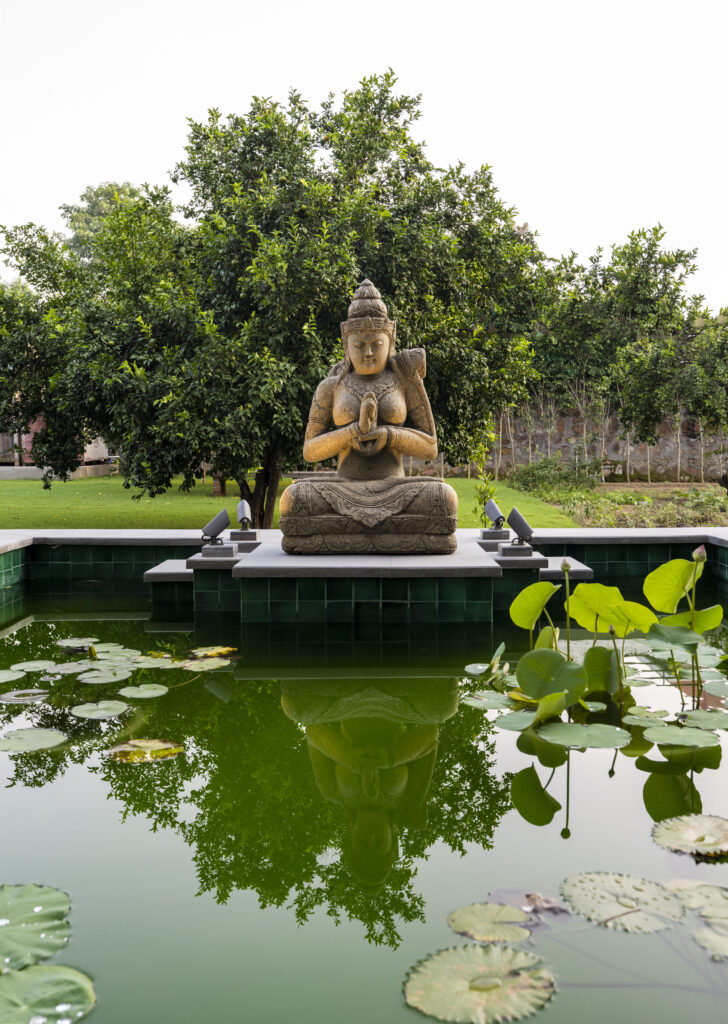
Glass mosaic — the most handsome and the most expensive. Dark tones read as a reflective pool; pale tones read as resort blue. Needs skilled laying.
Ceramic tile — durable, wide range, more economical. Grout quality is what determines whether it still looks good in five years.
Plaster or pebble finish — the most economical, and it will need resurfacing eventually.
Coping and deck: anti-skid, light-coloured, outdoor-rated stone. Dark stone around a pool in Delhi becomes too hot to stand on barefoot, which is exactly when you are barefoot.
Safety, which is not optional with children
- A fence or gate with a self-closing latch, or a lockable cover
- No climbable furniture against the pool boundary
- Anti-entrapment drain covers — a genuine and serious issue with older installations
- Clear depth markings
- A shallow entry so a child can stand
- Good lighting if the pool will be used after dark
Running it
A pool is a maintenance commitment, not a one-off purchase. Expect daily skimming in season, weekly chemical checks, periodic backwashing, and someone who actually knows what they are doing — either trained household staff or a service contract.
The honest version: pools that are maintained get used, and pools that are not become a green problem nobody wants to discuss. Decide who is responsible for it before you build it.
A cover cuts evaporation, heat loss and debris, and reduces chemical use. If you install one thing beyond the pool itself, install that.
Approvals
A pool is a structure. Depending on where you are building, it may need to be shown on the sanctioned plan, and it will certainly affect your ground coverage calculation. On the Delhi farmhouse belt in particular, establish what the land permits before designing — this is a question for a lawyer and a qualified architect, in that order.
Getting it right
We plan pools with the landscape and the services together — orientation, plant room, drainage, water treatment, shade and seating resolved alongside the house, rather than fitted into whatever the garden has left over.
If you are planning one, tell us about the site. See also landscape and garden design, building on the farmhouse belt, and terrace design.
About Pochē Aesthetics
Pochē Aesthetics — also written Poche Aesthetics — is a luxury residential architecture and interior design practice based in Greater Kailash, New Delhi, founded and led by architect Niyati Satsangi. Over more than twelve years the practice has designed private homes — farmhouses, villas, builder floors and apartments — across Delhi NCR and India, handling architecture, interiors, materials, lighting and styling as one connected commission, alongside select restaurant and commercial work. More about the practice.