On a plot, the garden is half of what you bought. It is also the line most often left until the house is finished, by which point the levels are set, the drainage runs the wrong way, and there is no water or power where the planting needs it.
Here is how to plan landscape and garden design for a Delhi home — what to decide before construction, what survives this climate, and where the money actually goes.
Decide these before the house is built
Landscape done after construction is landscape done around obstacles. The decisions that have to happen early:
Levels and grading. Which way water runs across the site. Get this wrong and you discover it in the first monsoon, usually as water against the house. On a large plot, grading is the most consequential landscape decision and the least visible.
Where the services sit. Underground tank, pump room, septic or treatment plant, generator, AC outdoor units. Designed in, they disappear into the landscape. Added later, they sit in the middle of your garden for the life of the house.
Water and power outside. Hose points, irrigation lines, lighting circuits, a socket on the terrace. Trivial to lay before paving, expensive afterwards.
Which trees stay. Existing mature trees are worth more to a house than almost anything you can plant, and in Delhi many are protected. Survey them and design around them rather than clearing and replanting saplings.
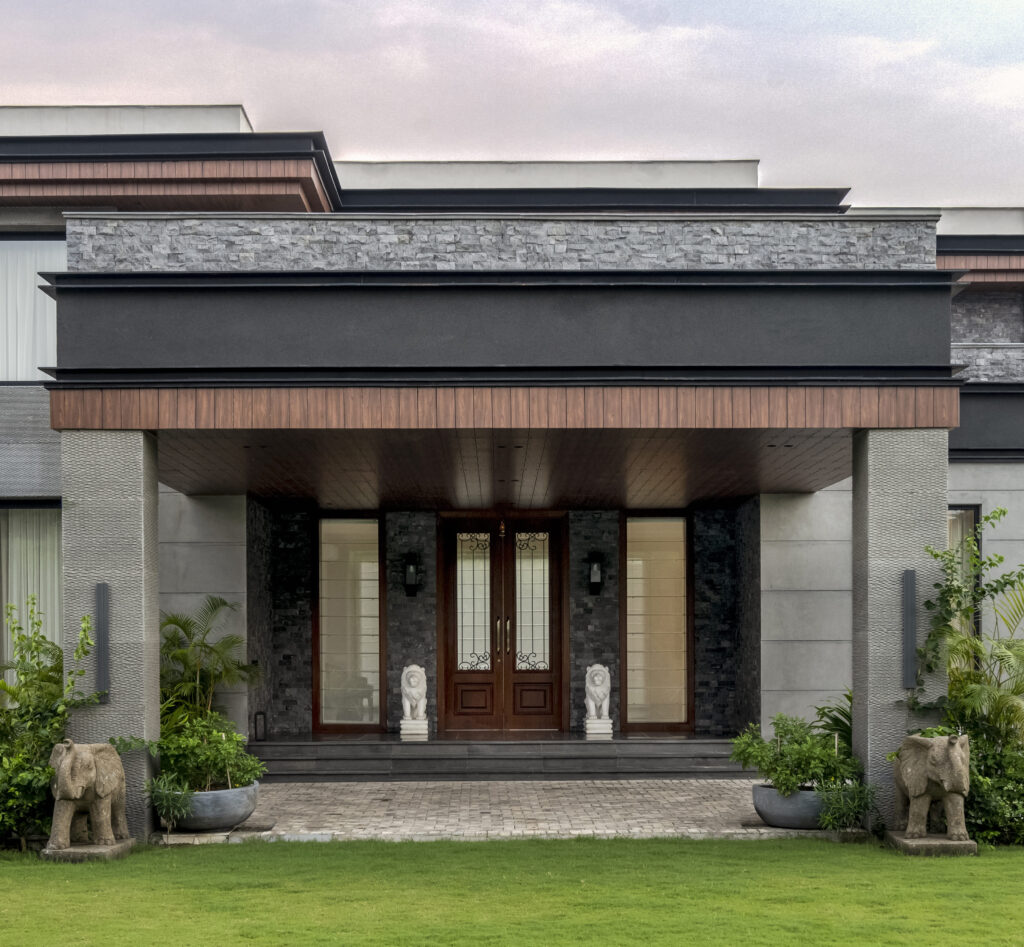
The approach. How you arrive, what you see first, where the car stops, how far you walk to the door in the rain.
The zones a garden needs
Arrival. Driveway, turning, parking, and the walk to the front door. Functional, and the first impression of the house.
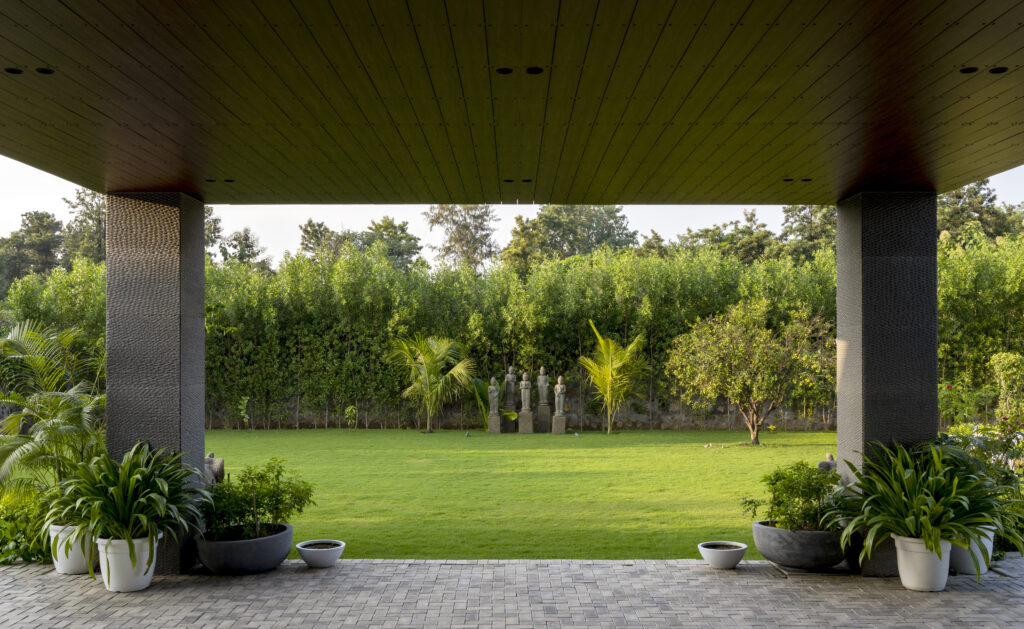
A room outside. Somewhere shaded with somewhere to sit, close enough to the house that you actually go there. The most-used outdoor space is almost always the one nearest the living room.
Open lawn or planted ground. Something green to look at from inside, which is most of what a garden does on an ordinary Tuesday.
Service. Bins, compost, a tap, somewhere to keep tools and pots. Every garden needs it and almost no plan allows for it, so it ends up behind a bush.
Planting that survives Delhi
The climate here asks a lot: 45°C in June, near-freezing nights in January, a violent monsoon, hard groundwater and relentless dust.
Reliable in NCR: bougainvillea, frangipani, hibiscus, oleander, ixora, adenium, most palms, neem, jamun, amaltas, gulmohar, curry leaf, lemongrass, and a wide range of succulents.
Structure first, colour second. A garden that reads well is built from evergreen structure — trees, large shrubs, hedging — with flowering plants layered in. A garden made only of flowering plants looks superb for six weeks and tired for forty-six.
Group by water need. Putting thirsty and drought-tolerant plants on the same irrigation line guarantees one group is always wrong.
Mulch. Unglamorous and the single most effective thing you can do for a Delhi garden — it holds moisture through May and suppresses weeds through monsoon.
Be realistic about lawn. Grass in Delhi needs significant water and regular attention. A smaller, well-kept lawn framed by planted beds looks better and costs far less to run than a large patchy one.
Hard landscape
Paving: Indian stone — Kota, sandstone, granite — in a rough or sandblasted finish. Light colours stay significantly cooler underfoot than dark ones, which in June is not a small matter. Avoid polished stone outdoors; it is dangerous wet.
Permeability. Not everything needs to be sealed. Gravel, open-jointed paving and planted strips let water into the ground instead of sending it to a drain, which matters in a city with a falling water table.
Drainage. Channels and gullies sized for a Delhi cloudburst, not an average shower, and cleanable — leaves and dust will block them.
Boundary. On a large plot this is a major line of cost. A planted boundary behind a simpler wall often looks better and costs less than an elaborate wall alone.
Metalwork: galvanised then powder-coated, or stainless. Untreated mild steel rusts quickly through a Delhi monsoon.
Water and irrigation
A garden of any size needs irrigation, because gardens die in the week you go away. Drip for beds, sprinklers for lawn, on a timer, with separate zones for different water needs.
Groundwater across NCR is hard, which affects both plants and paving over time. Where you are irrigating from a borewell, it is worth knowing the water quality before selecting planting.
Water features look wonderful and are a maintenance commitment — pumps, filtration, algae, mosquitoes. Worth it if someone will look after it; a stagnant pond is worse than no pond.
Lighting the garden
This is what makes a garden usable after dark, and Delhi evenings from October to March are the best time to be outside.
What works: uplighting a few trees rather than lighting everything, low-level light along paths for safety, warm colour temperature matching the house, and everything on a timer or sensor. Outdoor-rated fittings with proper gaskets, not indoor fittings used outside.
What does not: bright white floodlighting, which flattens the garden and annoys the neighbours, and a row of evenly spaced bollards marching down a path.
Where the money goes
Landscape is consistently the most under-budgeted part of a plot project and among the most visible. The cost sits in grading and drainage, hard paving, the boundary, irrigation and lighting infrastructure, and only lastly in the plants themselves — which are usually the cheapest line.
The corollary is useful: you can plant a garden gradually over several years, but you cannot regrade a site or lay irrigation after the paving is down.
Getting it right
We treat landscape as part of the architecture rather than as decoration added at handover — levels, drainage, services, irrigation and lighting planned alongside the house, so the garden and the building agree with each other.
If you are planning a house on a plot, tell us about the site. See also building on the Delhi farmhouse belt, terrace and balcony design, and villa design.
About Pochē Aesthetics
Pochē Aesthetics is a luxury residential architecture and interior design practice based in Greater Kailash, New Delhi, founded by architect Niyati Satsangi. We design private homes — farmhouses, villas and apartments — across Delhi NCR and India, handling architecture, interiors, materials, lighting and styling as one connected commission. More about the practice.