Delhi asks more of a material than almost any Indian city. Forty-eight degrees in June, high humidity through the monsoon, four degrees in January, hard water, and dust in a quantity that people from elsewhere find difficult to believe.
A material that performs beautifully in Bangalore can fail here in three years. This is a practical guide to what lasts in a Delhi NCR home and what does not.
The four conditions to design against
Heat. Surface temperatures on a west wall can exceed 50°C. Adhesives soften, timber moves, foils lift.
Humidity swing. From near-desert in May to 80 per cent in August. Timber and ply expand and contract with it — that cycle, not the heat itself, is what opens joints.
Hard water. Most NCR groundwater is hard. It scales taps, etches glass and leaves permanent white marks on polished stone.
Dust. Fine, constant, and abrasive. It settles on every ledge and dulls high-gloss surfaces over time.
Flooring
Works well:
- Vitrified tile — dimensionally stable, waterproof, indifferent to humidity. Large format in a matt or satin finish is the most practical floor in Delhi, and modern ones are far better looking than their reputation
- Indian marble — Makrana, Ambaji, Banswara. Stable, repairable, and beautiful. Honed rather than polished hides water marks and scratches far better
- Kota and other Indian stones — tough, inexpensive, excellent in circulation and outdoor-adjacent areas
- Engineered timber — the multi-ply construction resists humidity movement far better than solid wood. Acclimatise it on site before laying
Use with care:
- Solid hardwood — moves through the year. Gaps in winter, tight joints in monsoon. Possible, but needs expansion allowance and a client who accepts movement
- Imported white marble — stunning, and soft. It stains from turmeric, lemon and oil almost instantly. Wonderful in a bedroom, questionable in a kitchen
- High-gloss anything — shows every speck of dust within an hour of cleaning
Think twice about: laminate flooring in any area that might get wet. The core tends to swell, and a swollen plank usually cannot be saved.
Joinery materials
Carcass: BWR-grade plywood, 18mm, from a named brand. In bathrooms and kitchens, BWP or marine grade. Particle board and MDF absorb moisture readily, and tend not to recover once they have.
Shutters, best to worst for Delhi:
- Laminate — the most climate-tolerant option. Matt and textured finishes hide dust
- Veneer with PU polish — ages beautifully and can be refinished. Needs good polishing
- PU paint — stable, any colour, touchable-up. Softer than laminate
- Acrylic — fine performance, but fingerprints and dust are relentless on gloss
- Membrane / foil — in our experience the least forgiving option in Delhi heat, particularly at the edges. We tend to avoid it
Edge banding: 2mm PVC, machine applied. Hand-ironed thin banding is the most common failure point in Delhi joinery.
Bathrooms
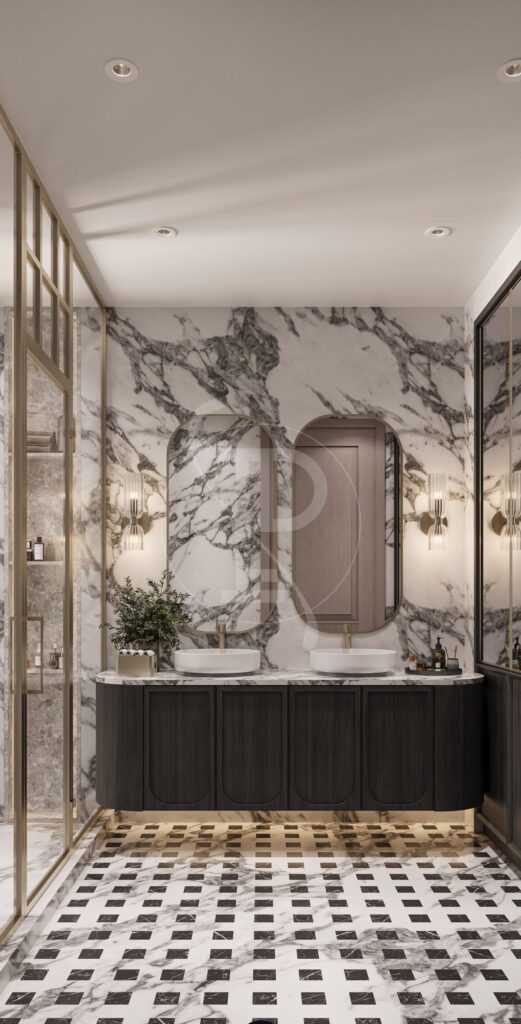
Hard water is the governing condition. It will mark anything it dries on.
Install a water softener. Everything else is mitigation; this is the actual solution. It protects taps, showers, glass and the kitchen at the same time.
Stone: honed over polished. Sealed on installation and resealed annually. Avoid very white porous marble at the wet end of a shower.
Glass: specify a factory-applied protective coating on shower screens. Untreated glass in hard water tends to etch, and once it does there is no cleaning it back.
Fittings: chrome is the most forgiving. Matt black and brushed brass look superb and show every water spot — fine if someone wipes them daily, frustrating otherwise.
Waterproofing: a proper membrane, taken 150mm up the walls and 1.8m in the shower, with a flood test before tiling. This is not the place to save.
Walls and ceilings
Paint: a washable emulsion in circulation areas. Matt looks best and marks easiest; a low-sheen finish is the sensible compromise where hands touch walls.
Wallpaper: works in bedrooms and studies. In humid months, poorly applied paper lifts at seams — insist on proper primer and a good adhesive.
Ceilings: moisture-resistant gypsum board in bathrooms and kitchens. Standard board is more prone to sagging in sustained humidity.
Textures and mouldings: every horizontal ledge is a dust shelf. In Delhi, simpler profiles stay looking clean.
Windows, glass and outside
Glazing: on west and south-west elevations, double glazing or a good solar-control glass pays for itself in comfort and running cost. On a large west window it is the difference between a usable and an unusable room in May.
Frames: uPVC and thermally broken aluminium both perform well. Timber frames need genuine maintenance here.
Terraces and balconies: anti-skid outdoor-rated tile or stone, laid to a proper fall, on tested waterproofing. Composite decking outperforms timber decking in Delhi sun by a wide margin.
External metal: galvanised then powder-coated, or stainless. Untreated mild steel tends to show rust quickly in Delhi monsoons.
The short version
Choose matt over gloss, honed over polished, engineered over solid, machine-finished over hand-finished, and softened water over untreated. Then spend the saving on the things you cannot change later — waterproofing, glazing and wiring.
Pochē Aesthetics specifies for this climate because we work in it every day — luxury homes across Delhi NCR where the finish is expected to look the same in year seven as in year one. If you are choosing materials for a home here, talk to us. See also how to judge joinery quality and what to expect in a Delhi renovation.
About Pochē Aesthetics
Pochē Aesthetics is a luxury residential architecture and interior design practice based in Greater Kailash, New Delhi, founded by architect Niyati Satsangi. We design private homes — farmhouses, villas and apartments — across Delhi NCR and India, handling architecture, interiors, materials, lighting and styling as one connected commission. More about the practice.
Pingback: Bathroom Renovation Cost in India | Realistic 2026 Ranges