“How much will this cost?” is usually the first question homeowners ask, and often the hardest one to get a straight answer to. Interior design pricing in Delhi NCR varies widely depending on finish level, customisation, and how a firm structures its fees. Here’s a realistic breakdown to help you budget before your first consultation.
What Actually Determines the Cost
Four things drive most of the variation in price: the level of customisation (modular versus made-to-order furniture), material quality (laminate versus veneer versus natural stone, for instance), the complexity of the layout, and the fee model your designer uses. Two homes of the same size can land at very different budgets depending on these choices alone.
Typical Price Ranges by Finish Level
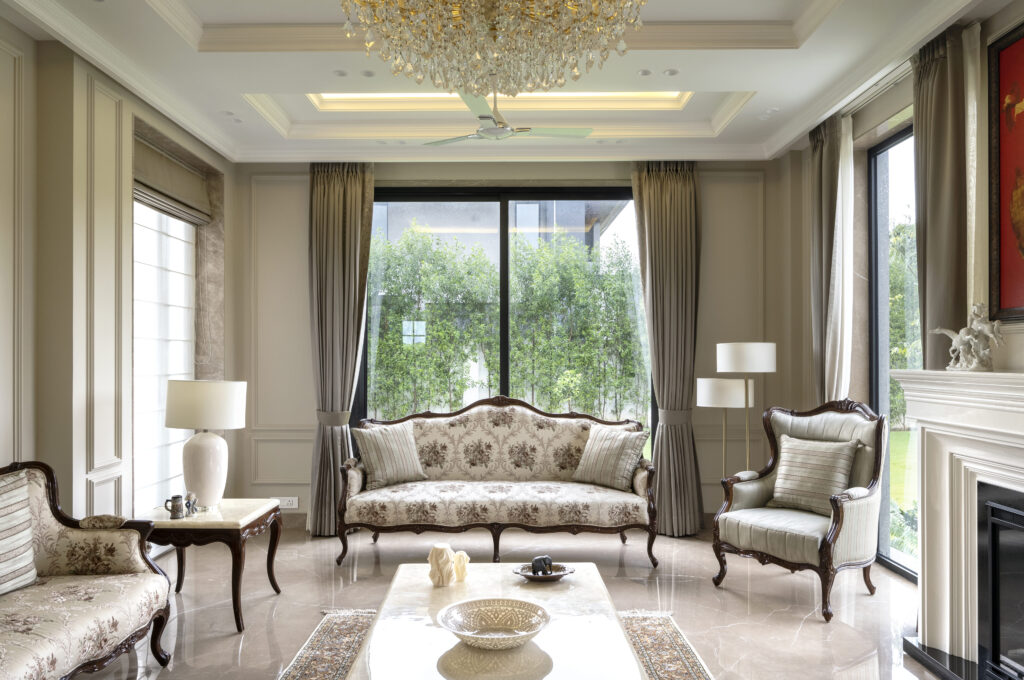
In practice, interior cost in Delhi NCR sorts into three broad tiers. Basic interiors use standard modular finishes and off-the-shelf materials. Mid-range interiors bring better materials, better hardware and some customisation. Fully bespoke, high-end interiors involve custom furniture, higher-grade materials and detailed millwork, and they scale with ambition rather than with area. The gap between the tiers is larger than most people expect — considerably larger than the gap between a small home and a big one at the same tier.
What a 2BHK, 3BHK, or Farmhouse Might Realistically Cost
Two flats of the same size can therefore sit a long way apart, and a 2 BHK done well can cost more than a 3 BHK done plainly. Farmhouses and larger independent homes do not scale the same way at all — cost per square foot is often higher because of larger volumes, indoor-outdoor transitions and more bespoke elements — so they are best estimated project by project rather than against any blanket rate.
What’s Usually Included vs Billed Separately
Design fees don’t always include execution. Ask explicitly whether your quote covers design only, or design plus project management and contractor coordination. Civil work, false ceiling and electrical modifications, and soft furnishings such as curtains, upholstery and rugs are commonly quoted separately from the core interior fit-out. Make sure you know which side of that line each cost falls on before you compare two quotes.
Budgeting for a Bespoke Project
If you’re commissioning a fully custom project, the kind where furniture is designed rather than selected, and every material is chosen rather than defaulted to, budget towards the higher end of these ranges, and set aside a contingency of 10 to 15 percent of the total for the decisions that only become clear once construction starts.
Getting an Accurate Number for Your Home
Every one of these ranges is a starting point for a conversation, not a substitute for one. The only way to get a number that means anything is to walk a designer through your actual space, your material preferences, and your priorities. Reach out to Pochē for a personalised estimate based on your home, not an industry average.
Frequently Asked Questions
Is per-square-foot pricing the best way to compare two quotes?
Only if you compare what’s actually included. A lower per-square-foot rate that excludes civil work, electrical, or soft furnishings can end up costing more once those are added back in. Always ask for a like-for-like scope before comparing numbers.
How much contingency should I budget beyond the quoted cost?
A commonly used buffer is 10 to 15 percent of the total project cost, to absorb site surprises, material upgrades, or scope changes that come up mid-project.
What you are paying for varies with the scope. Our three services — full architecture and interiors, interiors for an existing shell, or styling alone — sit at very different points on that range. You can also see the standard of finish those budgets produce.
About Pochē Aesthetics
Pochē Aesthetics — also written Poche Aesthetics — is a luxury residential architecture and interior design practice based in Greater Kailash, New Delhi, founded and led by architect Niyati Satsangi. Over more than twelve years the practice has designed private homes — farmhouses, villas, builder floors and apartments — across Delhi NCR and India, handling architecture, interiors, materials, lighting and styling as one connected commission, alongside select restaurant and commercial work. More about the practice.