Renovate if the location, the light and the structure are right. Move if any of those three is wrong, because none of them can be fixed. Everything else — a bad layout, an awful kitchen, dated finishes, insufficient storage — is solvable in a property you already own.
Here is how to decide whether to renovate or move, and the questions worth answering honestly before you commit either way.
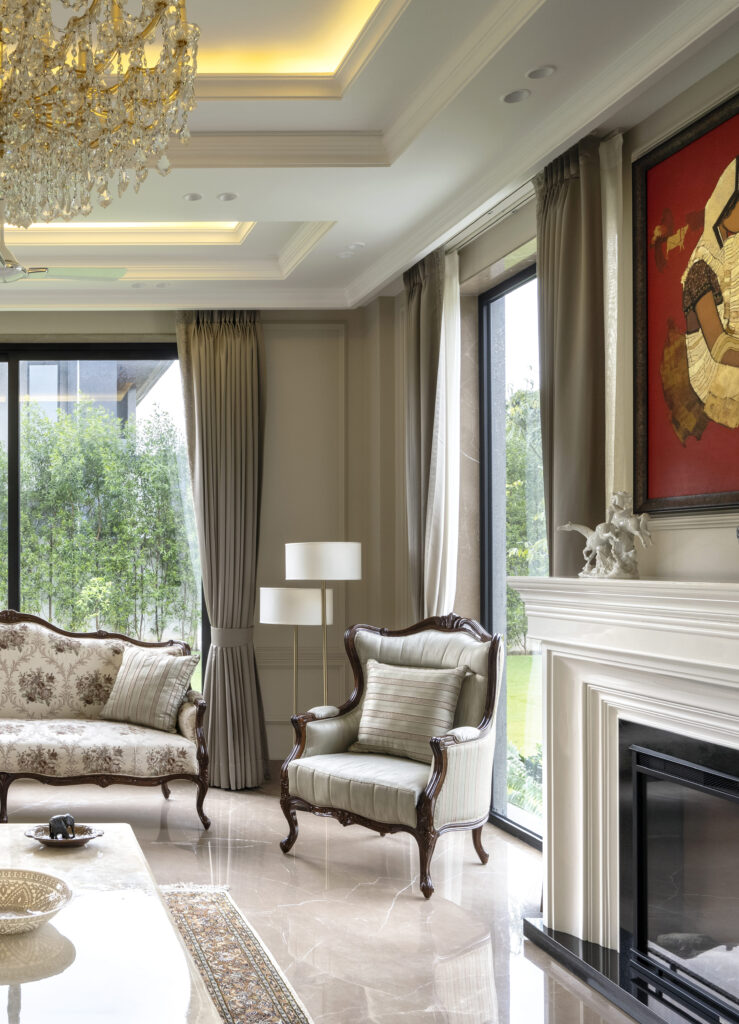
The three things you cannot change
Location
Schools, commute, family, the lane itself, who your neighbours are. If the location is wrong, no amount of work on the house fixes it, and you will resent the money.
Light and orientation
Which way the main rooms face, how much daylight reaches the middle of the plan, and whether the living room bakes from three in the afternoon through June.
You can mitigate a hot west elevation with shading and better glass, and you can borrow light across a plan with internal glazing. You cannot turn a north-facing dark flat into a bright one. If the home feels gloomy at noon in October, be realistic about what design can do.
The structural envelope
Ceiling height, the position of structural walls and columns, where the plumbing stack runs, the building’s own condition and the society it sits in.
Ceiling height in particular is worth checking with a tape before deciding. Under about 2.9 metres, a full false ceiling with services will make rooms feel low, and that is a permanent condition.
What renovation genuinely fixes
- A bad layout, within the limits of the structure. Non-structural walls usually move with permission
- An undersized kitchen, frequently by absorbing an adjacent utility
- Bathrooms, entirely
- Storage, which is almost always under-provided and almost always fixable
- Ageing services — full rewire and replumb
- Lighting, which transforms how a home feels more cheaply than any material
- The entrance, which in most flats does not exist and is inexpensive to create
- Every finish in the house
That is a long list, and it covers most of what people are unhappy about.
The honest cost comparison
Moving looks simpler than it is. Set against the cost of a renovation, a move carries stamp duty and registration, brokerage, legal fees, the moving itself, and — almost always — fitting out the new property anyway, because very few homes are bought in a state you would leave alone.
There is also the gap nobody budgets for: the new place will need work too, and you will be paying for two properties or paying rent during the overlap.
Renovating carries its own hidden costs, particularly on older buildings where wiring, plumbing and waterproofing turn out to need full replacement. But you are spending it on a property whose location and light you have already judged.
Questions to answer before deciding
- Would you buy this property again today, at today’s price, as it stands? If yes, renovate. If no, the problem may not be the finishes
- What is actually wrong — the home, or the location? People frequently blame a kitchen for a commute
- How long will you stay? Under three years, a full renovation rarely makes sense. Over seven, it almost always does
- What does the structural drawing allow? This decides whether the layout problem is solvable at all. Get it before deciding
- How much space do you actually need? If the honest answer is a whole extra bedroom and the plan cannot produce one, that is a moving decision
- Can you tolerate the disruption? A full renovation is months of your life, and more if you stay in it
When moving is clearly right
You need materially more space than the property can ever give. The location no longer suits your life. The building itself is poorly maintained or the society is difficult. The orientation makes the home uncomfortable and expensive to run. The structure prevents the layout you need. Or the property is on an unauthorised or unclear footing that will cause trouble later.
When renovating is clearly right
You like where you live. The light is good. The structure permits the plan you want. You intend to stay for the long term. And what you dislike is the arrangement and the finishes rather than the building.
In our experience this describes most people who think they want to move. The frustration is real; the diagnosis is often wrong.
A sensible middle step
Before committing either way, have an architect or designer walk the property with you. An hour on site establishes what the structure allows, what the hidden work is likely to involve, and whether the plan in your head can actually be built.
That hour frequently changes the decision in both directions — some people discover their home can become what they want, and others learn that it cannot, and stop spending money finding out slowly.
Frequently asked questions
Is renovating cheaper than moving?
Often, once you include stamp duty, registration, brokerage, legal fees, the move itself, and the fit-out the new property will also need. The comparison people make — renovation cost against purchase price — leaves most of the moving cost out.
What cannot be fixed by renovating?
Location, orientation and daylight, ceiling height, structural walls and columns, the position of the plumbing stack, the building’s condition and the society. Everything else is usually solvable.
How long should I plan to stay for a renovation to be worth it?
Under about three years, a full renovation rarely repays the cost or the disruption. Over seven, it almost always does. In between, it depends on how much of the work is hidden services, which benefit you daily but add little to resale.
Can I change the layout of my flat?
Within limits. In a framed building most internal partitions are non-structural and can be moved with a society NOC. In a shear-wall tower far more of the internal wall area is structural. Get the structural drawing before planning anything.
Should I renovate before selling?
Selectively. Kitchens, bathrooms and lighting generally improve saleability. A full bespoke renovation to your own taste rarely returns its cost, because the next owner will have different taste. If you are selling, fix what is broken and leave the rest neutral.
Getting it right
We are happy to walk a property with you before you decide, and to tell you honestly if renovating it is not the right answer. That is a shorter conversation than a project nobody should have started.
Tell us about the property. See also what to check before buying, what a renovation really involves, and builder floors in Delhi.
About Pochē Aesthetics
Pochē Aesthetics — also written Poche Aesthetics — is a luxury residential architecture and interior design practice based in Greater Kailash, New Delhi, founded and led by architect Niyati Satsangi. Over more than twelve years the practice has designed private homes — farmhouses, villas, builder floors and apartments — across Delhi NCR and India, handling architecture, interiors, materials, lighting and styling as one connected commission, alongside select restaurant and commercial work. More about the practice.