Flooring is the largest single surface in a house and one of the few decisions that is genuinely permanent. Everything else can be changed in ten years. The floor is laid once.
The question we are asked most often is marble vs granite flooring — and the honest answer is that it depends on the room, not on which stone is better. Here is how we choose, and what we recommend as the best flooring for Indian homes in each part of the house.
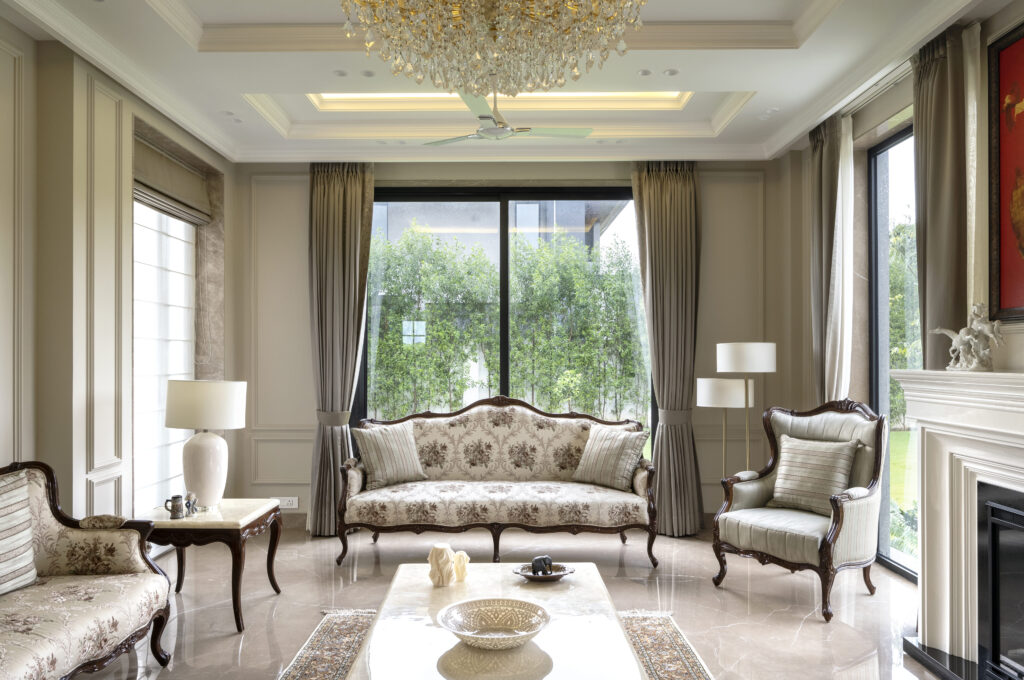
Marble vs granite: the real difference
Both are natural stone. The distinction that matters day to day is hardness and porosity.
Granite is an igneous rock — dense, extremely hard, and almost non-porous once sealed. It resists scratching and staining, takes heat without damage, and is close to indestructible in domestic use. It is also visually busy. Most granite has a speckled, granular pattern that is difficult to make look calm across a large floor.
Marble is metamorphic limestone — softer, more porous, and far more beautiful. It has movement and depth that granite cannot match. It also stains if you leave turmeric, wine or lemon on it, and it scratches. Marble asks something of you in return for how it looks.
Put simply: granite is the better material, marble is the better floor. In a luxury residential project we specify marble in the rooms people see and granite where performance matters more than appearance.
Cost, honestly
Indian marble — Makrana, Ambaji, Katni — sits broadly in the same range as good granite. Imported Italian marble such as Statuario or Calacatta costs several times more, and the price varies enormously with the block. Two slabs sold under the same name can differ hugely in quality, which is why we select stone at the yard rather than from a sample.
Room by room
Living and drawing rooms
Marble, in the largest format the stair and lift will allow. Fewer joints means a calmer floor. Ask for a honed or satin finish rather than a full mirror polish — it hides scratches, reduces glare, and looks considerably more expensive than high gloss.
If marble is beyond budget, a large-format vitrified tile in a plain finish reads far better than a cheap stone. What ruins a floor is not the material, it is a busy pattern and narrow tiles.
Kitchen
Granite or a full-bodied vitrified tile with an anti-skid finish. Not marble. Turmeric, oil and citrus will mark it within weeks, and in an Indian kitchen that is not a hypothetical risk.
Bathrooms
Anti-skid is not negotiable. Look for a surface rated R10 or better for a dry bathroom floor and R11 for a wet shower area. Small format tiles or mosaic in the shower give more grout lines, which means more grip and a better fall to the drain.
Marble works in a bathroom if you seal it properly and accept that it will patina. Many clients love that. Some do not — it is worth knowing which you are before committing.
Bedrooms
This is where engineered timber earns its place. It is warmer underfoot than stone, quieter, and it makes a bedroom feel like a bedroom. Engineered rather than solid — it handles Delhi’s humidity swings far better and is more stable over a slab.
Laminate is the budget alternative and it has improved, but it cannot be refinished and it does not tolerate standing water.
Terraces and balconies
Kota, sandstone or a textured outdoor porcelain. The floor must be laid to a fall of at least 1 in 100 towards the drain, and the waterproofing beneath matters more than the stone on top. Most terrace problems in Delhi homes are waterproofing failures, not material failures.
Staircase
Match the stone to the floor it lands on, and specify a honed finish with an anti-skid groove near each nosing. Polished marble on a stair is genuinely dangerous in humid weather.
The details that decide how a floor looks
Format
Large slabs in fewer pieces almost always look better than small tiles. In a 20 foot room, a 1200 x 1800 mm stone gives you a floor. A 600 x 600 tile gives you a grid.
Joints
Ask for a joint of 1 to 2 mm with a matched filler, not a 5 mm grout line. Grout the colour of the stone disappears; grout in a contrasting colour turns your floor into graph paper.
Continuity
Running the same floor through the living, dining and passage makes a home feel larger than any single design move. Change material where the function genuinely changes — into bedrooms, into wet areas — not at every doorway.
Skirting
A flush or shadow-gap skirting looks considerably more refined than a stone skirting stuck to the wall, and it costs about the same if it is planned before plaster. Planned afterwards, it is not possible at all.
Maintenance, realistically
Marble needs sealing before use and re-sealing every two to three years. Clean with a pH-neutral cleaner — never an acidic bathroom cleaner, which will etch the surface permanently. Wipe spills quickly, particularly turmeric, which will stain within hours.
Granite needs almost nothing beyond ordinary cleaning. Engineered timber needs a damp mop rather than a wet one, and felt pads under every chair leg.
If the thought of any of this is unappealing, be honest about it at selection stage. A beautiful floor that makes you anxious is not a good outcome.
What we would actually specify
For a typical luxury home in Delhi NCR: honed Indian or Italian marble in the living, dining and foyer; granite or full-body vitrified in the kitchen and utility; engineered oak in the bedrooms; anti-skid porcelain in bathrooms; Kota or textured porcelain on terraces. One stone running through all the public spaces, with material changing only where the room’s use changes.
That combination has served every project we have delivered, from apartments in Noida to farmhouses in Dera Mandi.
We select stone with our clients at the yard rather than from catalogues, because two slabs of the same name are rarely the same stone. You can read about how we run a project, look at finished homes, or tell us what you are planning.
About Pochē Aesthetics
Pochē Aesthetics is a luxury residential architecture and interior design practice based in Greater Kailash, New Delhi, founded by architect Niyati Satsangi. We design private homes — farmhouses, villas and apartments — across Delhi NCR and India, handling architecture, interiors, materials, lighting and styling as one connected commission. More about the practice.